

Fitbod vs Strong: Generated Workouts or Your Own Program?
Pick Strong if you already have a program. Free Strong logs unlimited workouts with up to three templates, and PRO costs $23.99 to $29.99 a year. Pick Fitbod if you want the app to choose the exercises, sets and weights. It has no free logging after a seven-day trial and costs $79.99 to $95.99 a year. If you want a fixed program with each set's weight and reps chosen for you, GainsLog, which I build, does that on iPhone and sets the targets on its free version.
Which is better, Fitbod or Strong?
It depends on who writes your program. Pick Strong if you follow a program you already have and want a fast log. The free version logs unlimited workouts and saves three templates, and you choose your own weights. Pick Fitbod if you want each workout built for you from your equipment, recovery and past sets, and are ready to pay for it, since there is no free logging after the seven-day trial. Checked in November 2026.
There is a third option. GainsLog, which I build, lets you follow the same workouts each week, as you would in Strong, and sets each set's weight and reps from what you logged, with the targets on its free version.
Since I build GainsLog, read this with that in mind. Strong is one of the apps I tried before I built GainsLog, as I wrote in the launch post. Fitbod's and Strong's prices and rules below come from their US and Swedish App Store listings and help centers, read on 6 November 2026. GainsLog's come from its App Store listing, its App Store Connect settings and its code.
Fitbod vs Strong at a glance
| Fitbod | Strong | |
|---|---|---|
| Who builds the workout | Fitbod, from your settings and logged sets | You, as templates |
| Next weight | Fitbod picks sets, reps and weight | You choose it |
| Free version | 7-day trial after choosing a plan, then view past workouts only | Unlimited logging, 3 templates |
| Monthly, US | $12.99 or $15.99 | $4.99 |
| Yearly, US | $79.99 or $95.99 | $23.99 or $29.99 |
| Yearly, Sweden | 869 or 1 195 kr | 245, 335 or 345 kr |
| Lifetime | Promotion only, 1,000 memberships | $79.99 or $99.99; 999 or 1 295 kr |
| Apple Watch | Logs sets; start and save on the iPhone | Logs with or without the iPhone |
| Your history | No Strong import or export described | CSV export; can't import it back |
Both listings carry more than one price for some plans and don't say which one the app will offer you (App Store, App Store). Strong's own description gives $4.99 a month or $29.99 a year. Fitbod's help center lists $15.99 a month or $95.99 a year and says prices vary by region, promotion and platform (Fitbod). Fitbod's lower yearly price on the listing, $79.99, is more than twice Strong PRO's higher one, $29.99. In Sweden it is 869 kr against 345 kr (App Store, App Store).
Some comparisons describe a different Fitbod free tier. SensAI's lists three free workouts (SensAI) and AIToolsBakery's five (AIToolsBakery). Fitbod's help center describes a seven-day trial that starts when you pick a monthly or yearly plan. After it ends you can still log in and view past workouts, but logging new ones needs a subscription (Fitbod).
What Fitbod does that Strong doesn't
Fitbod builds each workout from the goal, experience level, equipment, training split and preferences in your My Plan settings, and from what you've logged. It picks exercises that fit your goal and equipment, sets how many from the workout length you chose, and works around muscle groups it estimates haven't recovered, on a scale from 0% to 100% (Fitbod). You can set up several gym locations, each with its own equipment (Fitbod).
Fitbod also picks the sets, reps and weight. If you complete an exercise with ease, it raises the load or reps; if you struggle, later recommendations come down. Its mStrength system varies intensity on purpose, so some sessions have higher reps at a lower weight and others heavier sets with fewer reps, and Max Effort Days end with two sets of as many reps as possible (Fitbod).
For each muscle group Fitbod sets a weekly set target, which you can't edit, and its help center says: "Fitbod's workout algorithm does not guarantee that following the suggested workouts will fully meet your weekly set targets. This is a known limitation", and adds that improvements are being explored (Fitbod). Until then it suggests adding exercises yourself for muscles that fall short.
Fitbod also decides how often your exercises change. The Exercise Variability setting starts on Balanced, a mix of consistency and variety; More Consistent keeps 70 to 80% of exercises each week, and Fitbod lists it as the setting for progressive overload (Fitbod). My own rule is to pick one exercise per muscle group, preferably a machine, and if you start to dread one, swap it for another that trains the same joint action. If you train that way, use a saved workout in Fitbod, covered below, or a template in Strong. Fitbod's More Consistent setting keeps most exercises but, going by its own 70 to 80% figure, still lets 20 to 30% change each week.
What Strong does that Fitbod doesn't
Strong is a log for the program you bring. Its listing says it is optimized for a progressive barbell routine such as Starting Strength or StrongLifts 5x5 and adapts to any routine you choose. Its listing names a rest timer, supersets, warm-up, failure and drop-set tags, and statistics for personal records and estimated one-rep max (App Store). Strong's listing and help pages describe no feature that sets your next weight, so you decide when to add it.
The free version keeps working without a time limit. It saves unlimited workouts and up to three templates (App Store, Strong). Strong PRO adds unlimited templates, body part measurements, all charts and the plate and warm-up calculators, and Strong says your workout data stays available whether or not you pay (Strong). The Strong help pages cited here date from 2021.
Can Fitbod run your own program?
Partly. Fitbod lets you save a workout and load it again with three options: keep the saved sets, reps and weight, generate new weights only, or generate everything new. It has no built-in weekly planner yet; its help center suggests saving one workout per training day, such as "Monday" or "Push Day". Generating new weights only also changes an exercise with varied reps, such as 12, 10 and 8, to a single rep count (Fitbod). Focus Exercises are another option. They add a main strength exercise to each training day that repeats weekly for four weeks, with reps and weight adjusted automatically (Fitbod).
So Fitbod can log a fixed program and update its weights, within those limits. If you only want to log a program of three workouts or fewer and choose the weights yourself, free Strong does that without a subscription.
On the Apple Watch
Strong's listing describes an Apple Watch app that logs workouts with or without your iPhone (App Store). Fitbod's watch app is a companion to the iPhone app. You start the workout on the iPhone, and swapping or adding exercises and saving the workout also need the phone. During the workout the watch logs sets, adjusts reps and weight, runs the rest timer and shows your heart rate. Fitbod's watch page lists iOS 18 and watchOS 10 or later as requirements, and the watch app doesn't support the Always On display (Fitbod).
Both apps also run on Android. Strong sells PRO on Google Play (Strong), and Fitbod supports Android and Wear OS (Fitbod).
Moving your history between them
Strong exports your workouts as a CSV file from its settings, and says the file can't be imported back into Strong (Strong). Fitbod's help center describes importing cardio workouts from Fitbit and Android's Health Connect (Fitbod, Fitbod) and writing completed workouts to Apple Health (Fitbod). It describes no import of a Strong export and no file export of your sets and weights. If you switch in either direction, plan on starting a new log. Free Strong keeps your old workouts viewable, and after Fitbod's trial ends you can still view past workouts there (Fitbod).
Who should pick which
- Free Strong, if your program has three workouts or fewer and you're happy choosing your own weights.
- Strong PRO, if you want more templates, all charts and the calculators. It lists $23.99 or $29.99 a year in the US and 245 to 345 kr in Sweden, or a lifetime purchase at $79.99 or $99.99 (App Store, App Store).
- Fitbod, if you don't want to plan at all, train at more than one gym, or want the app to work around muscles that haven't recovered, and $79.99 to $95.99 a year is worth that to you.
- If you want Fitbod for years, its help center says only 1,000 lifetime memberships are sold, typically during its Black Friday and Cyber Monday sale week, with the price announced then and no cancellation or refund (Fitbod).
- GainsLog, if you want to repeat the same workouts each week and have each set's weight and reps set for you on a free version.
Where GainsLog fits
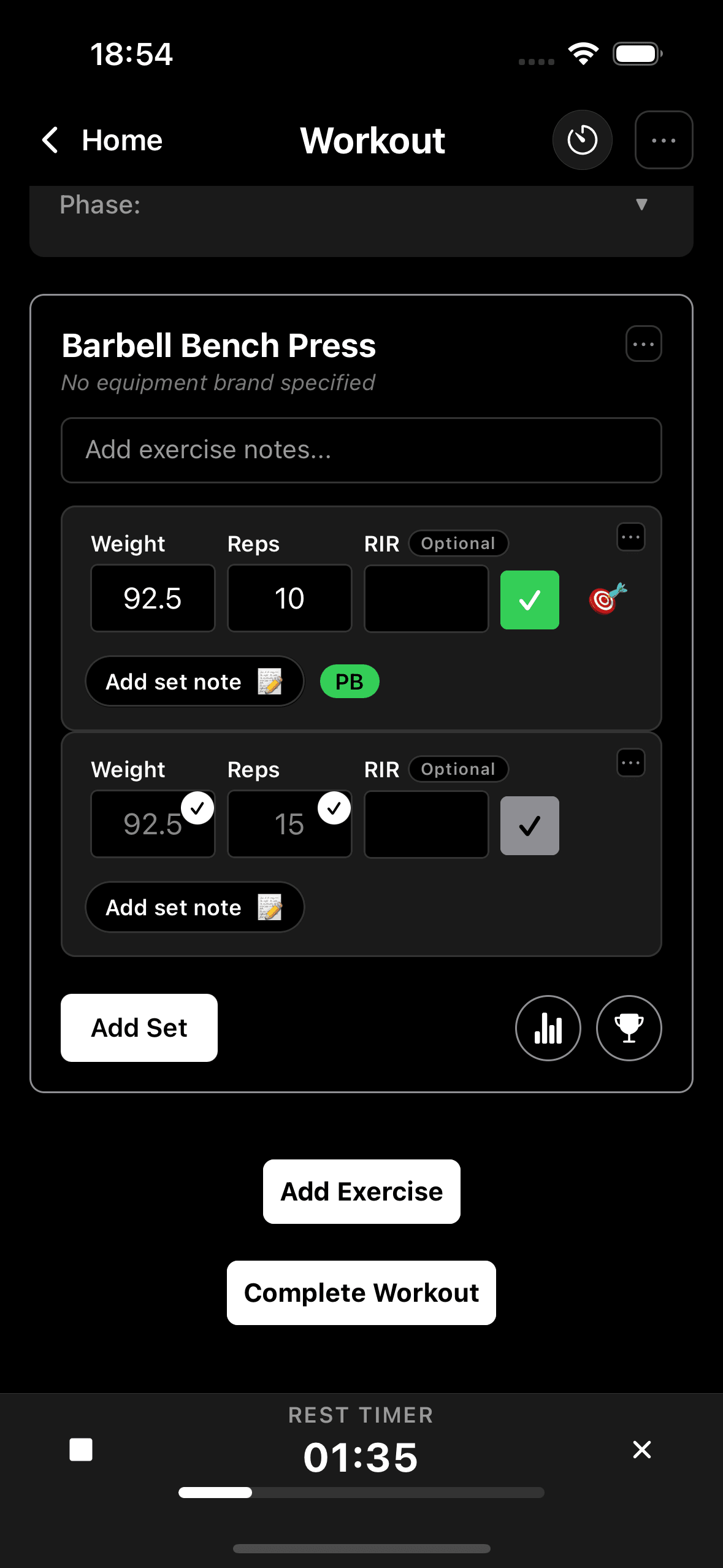
GainsLog is a workout app for iPhone and iPad, with an Apple Watch companion, for lifters who want to build muscle and be told what to lift each session. You follow the same workouts each week, as in Strong, and GainsLog sets each set's weight and rep targets from the weight, reps and reps in reserve you logged, plus an RIR target in some cases. The targets are part of the free version, which also logs unlimited workouts and saves three workouts.
Premium adds the program builder and ready-made programs, where each program is one week of workouts that repeats, plus custom exercises and trends, among other features. The app offers new buyers $5.99 a week with a free trial or $39.99 a year without one in the US (79 kr or 499 kr in Sweden). A lifetime purchase, $79.99 or 999 kr, unlocks Premium without Gains Coach, its AI coach.
GainsLog is the wrong pick if you're on Android (it is in closed beta there), if you want to bring your history from Strong, since it has no import, or if you want each workout rebuilt around your recovery the way Fitbod does. Its listing counts 100+ exercises, prioritizing machines (App Store). The head-to-heads are GainsLog vs Fitbod and GainsLog vs Strong.

More on each app
The Fitbod review covers Fitbod's cancel and refund rules, and Fitbod alternatives lists apps like it. Strong app alternatives covers what to switch to from Strong, and Hevy vs Strong and Fitbod vs Hevy compare each with Hevy.
If you want the program fixed and the weights set for you
If you'd rather follow the same workouts each week and have each set's weight and reps chosen from what you logged, see how GainsLog works.
How this article was made
Researched and drafted with AI assistance from Fitbod's and Strong's App Store listings and help centers and from GainsLog's code, checked against those pages on 6 November 2026. Prices change, so the pages used are listed below.
Sources
- Fitbod help: how the trial works
- Fitbod help: how to subscribe: prices
- Fitbod help: lifetime membership
- Fitbod help: how Fitbod creates your workout
- Fitbod help: how Fitbod decides sets, reps and weight
- Fitbod help: weekly set targets
- Fitbod help: exercise variability
- Fitbod help: My Plan: gym locations
- Fitbod help: saving a workout
- Fitbod help: Apple Watch
- Fitbod help: system requirements
- Fitbod help: Fitbit: imported workouts
- Fitbod help: Health Connect on Android: imported workouts
- Fitbod on the US App Store: prices
- Fitbod on the Swedish App Store: prices
- Strong on the US App Store: prices, features, Apple Watch
- Strong on the Swedish App Store: prices
- Strong help: what Strong PRO includes
- Strong help: templates
- Strong help: exporting your data
- SensAI: Hevy vs Strong vs Fitbod: Fitbod free tier as described there
- AIToolsBakery: Fitbod vs Strong: Fitbod free tier as described there
- GainsLog on the US App Store: exercise library