

GainsLog vs Fitbod: Which to Pick and Where Fitbod Wins
I build GainsLog, so weigh this page with that in mind. Pick Fitbod if you train in more than one place with different equipment, want a new workout built around the muscles that have recovered, or use Android. Pick GainsLog if you're on iPhone and want the same workouts every week so you can beat last week's numbers on the same exercises. Generated workouts are paid on Fitbod, and starting a GainsLog program is paid too. Without paying, GainsLog still logs your workouts and sets each session's weight and reps from what you logged, while Fitbod needs a subscription to log new workouts once its seven-day trial ends. A year of Fitbod is listed at $79.99 or $95.99, and a year of GainsLog Premium at $39.99.
Table of Contents
- Which is better, GainsLog or Fitbod?
- GainsLog vs Fitbod at a glance
- A new workout each session, or the same week repeated
- How each app sets the weight
- Weekly sets per muscle
- What you get without paying
- What GainsLog and Fitbod cost
- Where Fitbod is better
- GainsLog or Fitbod: which one to pick
- If you want a program you repeat and targets set for you
- How this article was made
- Sources
Which is better, GainsLog or Fitbod?
It depends on how you want your workouts made. Pick Fitbod if you train at more than one gym, want a new workout built around the muscles that have recovered, or use Android. Pick GainsLog if you're on iPhone and want to repeat the same workouts each week and beat last week's numbers. GainsLog's free version logs your workouts and sets each session's weight and reps. Fitbod needs a subscription to log after its seven-day trial. As of October 2026, a year of Fitbod is listed at $79.99 or $95.99 in the US, and GainsLog Premium at $39.99.
Every Fitbod fact below comes from Fitbod's help center and App Store listings, checked on 13 October 2026. GainsLog's prices and platforms come from its App Store listing, checked the same day, and what its program builder and free version do comes from the app's code.
GainsLog is listed on the App Store as "GainsLog: Workout Log". It isn't the same app as Gains (gains.la), a different iPhone tracker.
GainsLog vs Fitbod at a glance
Fitbod's terms come from its help center and its listed products from the US App Store. GainsLog's come from its US listing and the Premium page.
| Fitbod | GainsLog | |
|---|---|---|
| AppsFitbod doesn't support iPad. GainsLog's Android app is in closed beta, and its Apple Watch app continues a workout you start on the iPhone. | iPhone, Apple Watch, Android, Wear OS | iPhone, iPad, Apple Watch |
| How workouts are made | A new workout each session from your settings, history and recovery | A program that repeats the same workouts each week (Premium) |
| Next weight and reps | Set from your history (subscription) | Set from your history (free) |
| Weekly sets per muscle | Targets you can't edit | Shown per muscle before you start (Premium) |
| Without paying | 7-day trial, then a subscription to log | Unlimited logging, targets, 3 saved workouts |
| Paid plan, weekly | Not listed | $5.99, with a free trial |
| Paid plan, monthlyFitbod's help center gives $15.99. GainsLog's listing shows a $14.99 product that the Premium page doesn't offer. | $12.99 or $15.99 | Not on the Premium page |
| Paid plan, yearlyFitbod's help center gives $95.99. | $79.99 or $95.99 | $39.99 |
| On the App Store sinceUS ratings and average on 13 October 2026 | 2015, 287,152 ratings (4.8) | 2025, 3 ratings (4.3) |
A new workout each session, or the same week repeated
Fitbod builds each workout from your settings and the training you've logged. The settings cover goal, equipment, workouts per week, session length, experience and split. Fitbod then picks exercises by your equipment, your feedback and which muscles have recovered. Each muscle group gets a recovery percentage from 0 to 100%, an estimate based on what you logged (Fitbod).
Fitbod also changes the exercises on purpose. Its default variability setting, Balanced, mixes repeats with new exercises. More Consistent keeps 70 to 80% of the exercises each week, and Fitbod lists it as the setting for progressive overload (Fitbod). Focus Exercises add one main lift to each training day that repeats weekly for four weeks (Fitbod).
GainsLog builds the program once. The program builder asks what equipment you train with, your experience, which muscles to prioritize (one, or up to two on the Advanced setting), how many days a week you can train, how long a session can be and which split you want. It shows the whole plan before you start. The program runs for a set number of weeks. On a weekly schedule, each workout repeats every week with the same exercises, and when you finish one, GainsLog creates next week's version with weight and rep targets from the sets you just logged. You can swap an exercise, and the substitutes the app suggests train the same muscle, by default through the same joint movement.
Fitbod's own help says repeating exercises makes progress easier to track (Fitbod). Its case for variety is that it keeps you from plateauing (Fitbod). Neither app's documentation shows that one approach builds more muscle, and this page doesn't claim it. If you want a different workout most days, that's a reason to pick Fitbod.
How each app sets the weight
Fitbod sets weight and reps from what you logged. Finish an exercise comfortably and it raises the load or the reps. Struggle and it eases back. It varies intensity between sessions on purpose, so some days are lighter than your last one, and it schedules Max Effort Days with two as-many-reps-as-possible sets to re-estimate your strength. You can rate each set in reps in reserve (RIR), from 0 to 4 or more (Fitbod).
GainsLog sets a weight, rep and RIR target for every set from what you logged on that exercise, and it does that on the free version. The weight-progression guide explains when a target goes up.
Weekly sets per muscle
Both apps use weekly sets per muscle, in different ways. Fitbod sets a weekly target for each muscle group from your goal, schedule, session length, experience and past volume. You can't currently edit them directly, Fitbod shows your progress against them as you log, and its help center says its "workout algorithm does not guarantee that following the suggested workouts will fully meet your weekly set targets" (Fitbod).
GainsLog shows the weekly sets and training days for each muscle in the plan before you start, with a score for the split. The score checks each muscle against a weekly range and can tell you the split needs tweaks. For back, shoulders and quads the range is 5 to 12 sets, and a muscle you prioritize gets 10 to 15. Other muscles have their own ranges, and some differ between men and women. The volume calculator on this site uses the same numbers as the app. Because each week repeats the plan, the sets you see before you start are the sets the program asks for every week.

What you get without paying
Fitbod is paid after its trial. The seven-day trial starts when you pick a monthly or yearly plan, and it renews into a paid subscription unless you cancel. After that you can view past workouts, but logging new ones needs a subscription (Fitbod).
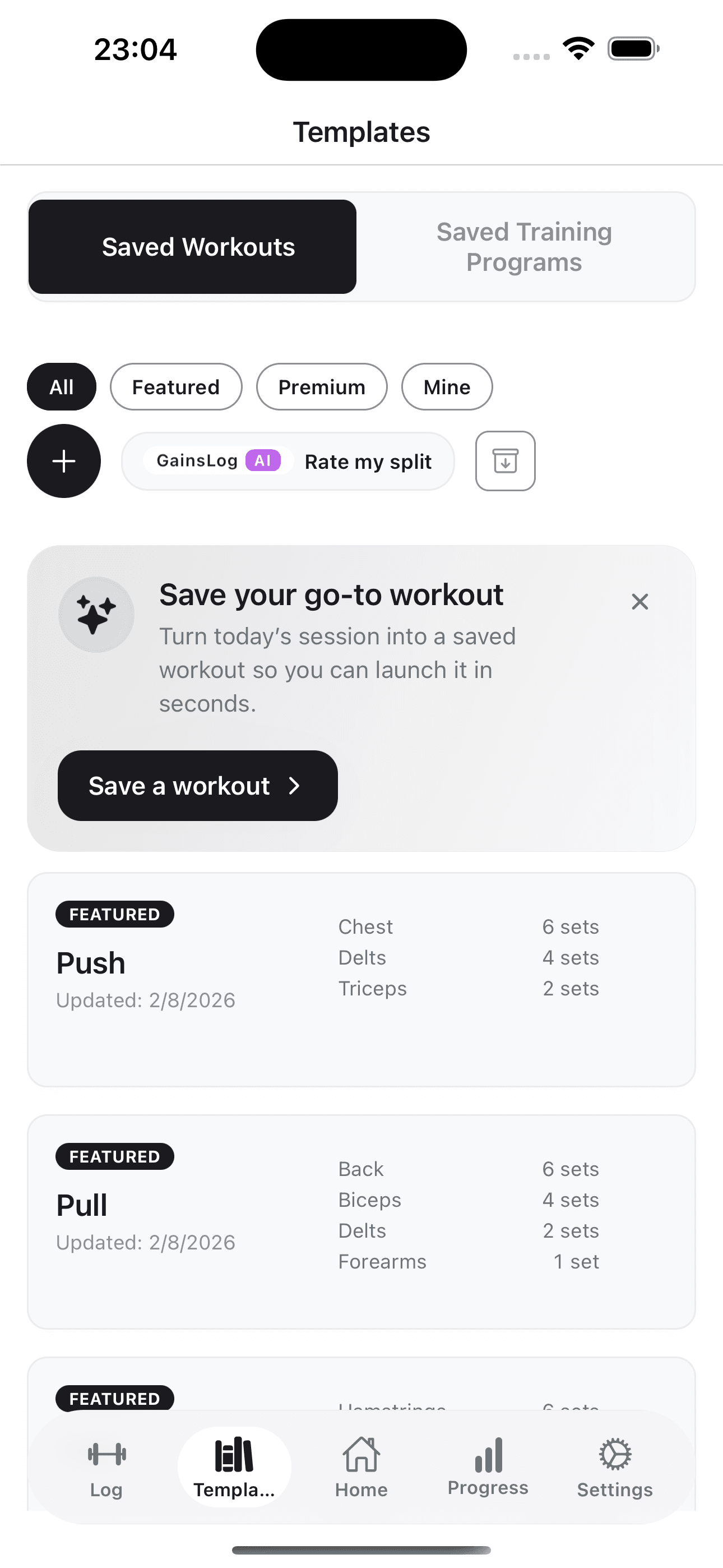
GainsLog's free version logs unlimited workouts and sets weight, rep and RIR targets for every exercise you've logged before. It saves up to three workouts and gives you one smart workout suggestion a week. Premium adds the program builder and programs, unlimited saved workouts and suggestions, custom exercises, the Momentum trend and muscle drill-downs, records and the estimated-1RM trend, and workout photos.
What GainsLog and Fitbod cost
Fitbod's help center lists $15.99 a month or $95.99 a year and says prices vary by platform and region (Fitbod). Its US App Store listing shows a $12.99 and a $15.99 monthly plan and a $79.99 and a $95.99 yearly plan, plus older products marked as legacy pricing (App Store).
GainsLog Premium is $5.99 a week with a free trial, or $39.99 a year (Premium). Its listing also shows a $29.99 yearly offer and two products named Gains Premium, at $14.99 and $49.99, that the Premium page doesn't offer (App Store).
Compare the yearly plans. A year of GainsLog Premium costs $40 less than Fitbod's $79.99 plan and $56 less than its $95.99 plan. Paying GainsLog weekly for a whole year would cost $311.48, so the yearly plan is the one to compare. Check the offer each app shows you before you pay.
Where Fitbod is better
- More devices. Fitbod runs on iPhone, Apple Watch, Android and Wear OS (Fitbod). GainsLog runs on iPhone, iPad and Apple Watch, and its Android app is in closed beta.
- Equipment by location. Fitbod lets you list the equipment at each gym, including which weight increments you have for dumbbells, kettlebells and barbells, and switch between locations (Fitbod). GainsLog's builder offers four setups: full gym, home gym, dumbbells only, and bodyweight or minimal equipment.
- Workouts that follow your recovery. Fitbod works around muscles it estimates haven't recovered, and it lowers the weights after a break (Fitbod). A GainsLog program keeps the same workouts from week to week.
- A larger library. Fitbod's help center lists over 1,600 exercises with demonstration videos (Fitbod). GainsLog's listing says 100+ exercises, prioritizing machines and movements that build an aesthetic physique (App Store).
- More than lifting. Fitbod can add cardio, stretching, circuits and timed intervals to a workout (Fitbod) and connects to Strava and Fitbit (App Store).
- A longer record. Fitbod has been on the App Store since 2015 and had 287,152 US ratings averaging 4.8 on 13 October 2026 (App Store). GainsLog came out in November 2025 and had 3, averaging 4.3, too few to compare (App Store).
GainsLog or Fitbod: which one to pick
- Pick Fitbod if you use Android, train at more than one gym, like a different workout most days, or want cardio and stretching planned in the same app.
- Pick GainsLog if you're on iPhone and want to repeat the same workouts and beat last week's numbers. Use the free version if you already have a program and want your next targets set. Pay for Premium if you want the program built for you at $39.99 a year. GainsLog can't import a Fitbod history, so switching means starting a new log.
- If you like Fitbod but want more repetition, two settings give you more of it without switching. More Consistent keeps 70 to 80% of the exercises each week (Fitbod), and on the Build Muscle, Get Lean and Get Stronger goals, Focus Exercises repeat one main lift weekly for four weeks (Fitbod).
- If you'll pay either way, Fitbod plans more of each session around your equipment and recovery. GainsLog costs $40 to $56 less a year and shows each muscle's weekly sets before you start.
- If Hevy is on your list too, see Fitbod vs Hevy and GainsLog vs Hevy.
If you want a program you repeat and targets set for you
If you'd rather run the same workouts each week and have each set's weight and reps set from your last session, see how GainsLog works.
How this article was made
Researched and drafted with AI assistance from Fitbod's help center and App Store listings and GainsLog's App Store listing and code, then checked against those pages on 13 October 2026. Prices change, so the pages used are listed below.
Sources
- Fitbod help: how the trial works: trial terms, logging after the trial, prices
- Fitbod help: how to subscribe: prices and how they vary
- Fitbod help: system requirements: platforms
- Fitbod help: how Fitbod creates your workout: inputs, recovery, variation, library
- Fitbod help: how Fitbod decides sets, reps and weight
- Fitbod help: My Plan: equipment, locations, Focus Exercises, cardio
- Fitbod help: exercise variability
- Fitbod help: weekly set targets
- Fitbod on the US App Store: listed prices, integrations, ratings
- GainsLog on the US App Store: prices, platforms, exercise library, ratings