

Is Fitbod Worth It? What $95.99 a Year Gets You
Fitbod is worth $95.99 a year if you want the app to build each workout for you from your equipment, your logged sets and its estimate of which muscles have recovered, and you're fine with exercises that change between sessions. It isn't worth it if you only want to log a program you already follow. Fitbod has no free version, and after the seven-day trial you can view past workouts but not log new ones without paying. Cancelling stops the next charge but doesn't refund the current period. If you want a fixed program with weight and rep targets at no cost on iPhone, GainsLog, which I build, is an alternative.
Is Fitbod worth it?
It depends on whether you want the app to plan every workout. As of October 2026, Fitbod costs $15.99 a month or $95.99 a year on its website, after a seven-day free trial that starts when you pick a plan. Pay if you want a new workout built for you each session from your equipment, your logged sets and Fitbod's estimate of which muscles have recovered. Don't pay if you already follow a program and want a log, because Fitbod has no free logging after the trial.
I build GainsLog, a workout app that competes with Fitbod, so read this with that in mind. Every Fitbod price, limit and rule below comes from Fitbod's help center, its website and its US and Swedish App Store listings, read on 29 October 2026. There are no affiliate links or discount codes on this page.
Is Fitbod free?
No. New users get a seven-day trial, and you pick a monthly or yearly plan to start it. The trial turns into a paid subscription unless you cancel before it ends, and if you started it in the App Store, Apple needs the cancellation at least 24 hours before the end. After the trial, workouts generated from your history stop, and you can still log in and view past workouts, but logging a new workout needs a subscription (Fitbod).
Some reviews, such as TechRadar's and Dr. Muscle's, still describe three free workouts. That was the offer in earlier versions of the app, before the seven-day trial (Garage Gym Reviews). Fitbod's own subscription page now describes a seven-day trial for new users (Fitbod).
What Fitbod costs, as of October 2026
| Website (US) | US App Store | Swedish App Store | |
|---|---|---|---|
| Monthly | $15.99 | $12.99 or $15.99 | 139, 179 or 199 kr |
| Yearly | $95.99 | $79.99 or $95.99 | 869 or 1 195 kr |
| Free trial | 7 days | 7 days | 7 days |
Fitbod's help center lists $15.99 a month and $95.99 a year, about $8 a month on the yearly plan, and says prices vary by region, promotion and platform (Fitbod, Fitbod). The App Store listings show two or three different prices for each plan, plus older products named "(Legacy Pricing) fitbod ELITE", and don't say which one you'll be offered (App Store, App Store). Check the price on the paywall before you start the trial. At the website prices, the yearly plan costs about the same as six months of the monthly one.
Fitbod also sells two shared plans on its website, yearly only: Duo for two people at $159.99 and Family for up to five at $359.99. Each person gets their own account and recommendations (Fitbod, Fitbod). Fitbod can't be shared through Apple Family Sharing (Fitbod). The website also takes FSA and HSA funds through a partner called Flex, if Flex approves you (Fitbod).
A lifetime membership is only sold as a promotion. Fitbod's FAQ says 1,000 are available, typically during its Black Friday and Cyber Monday sale week, that the price is announced then, and that a lifetime membership can't be cancelled or refunded (Fitbod).
What the subscription gets you
You pay for the workouts Fitbod builds. Each one comes from your My Plan settings and the training you've logged. Fitbod picks exercises for your goal and equipment, sets the number of exercises from the session length you chose, and works around muscle groups it estimates haven't recovered. Each muscle group gets a recovery percentage from 0 to 100%, which is an estimate from what you logged, not a measurement (Fitbod).
Fitbod chooses your sets, reps and weight from your logged sessions. Finish an exercise comfortably and it raises the load or the reps; struggle and it eases back. It varies intensity between sessions on purpose, so a lighter day is part of the plan, and it schedules Max Effort Days, a few lighter ramp-up sets followed by two as-many-reps-as-possible sets, to re-estimate your strength. You can rate each set in reps in reserve, from 0 to 4 or more. After a break it lowers the weights, and an exercise you've never done starts light (Fitbod).
The exercises change on purpose too. The default setting, Balanced, mixes repeats with new exercises. More Consistent keeps 70 to 80% of the exercises each week, and Fitbod lists it as the setting for progressive overload (Fitbod).
Fitbod also sets a weekly set target for each muscle group from your goal, schedule, session length, experience and past volume. You can't currently edit the targets, only the settings behind them. Fitbod's help center says its "workout algorithm does not guarantee that following the suggested workouts will fully meet your weekly set targets", calls this "a known limitation" and says improvements are being explored (Fitbod). How many sets a muscle needs is covered in the training volume guide.
You can list the equipment at each gym, including the weight increments of your dumbbells, kettlebells and barbells, and switch between locations (Fitbod). Fitbod runs on iPhone, Apple Watch, Android and Wear OS, and says it doesn't currently support iPad (Fitbod). Its US listing names Apple Health, Strava and Fitbit integrations (App Store).
Cancelling, refunds and pausing
You cancel where you subscribed: in your Apple ID's subscriptions, in Google Play, or on Fitbod's website. Cancelling stops future charges but doesn't refund the current period, and you keep access until the next billing date. Deleting your Fitbod account doesn't cancel the subscription (Fitbod).
Refunds also go through the place you paid. For an App Store purchase you ask Apple at reportaproblem.apple.com, and Apple decides. For a purchase on the website you email Fitbod's support with your receipt (Fitbod).
Monthly subscribers can sometimes pause instead. Fitbod offers eligible website subscribers a one-month pause, and Google Play subscribers can pause for one to three months. Yearly plans and trials can't be paused, and you can't log workouts during a pause (Fitbod).
What Fitbod doesn't do
- No free logging. After the trial, logging a workout needs a subscription (Fitbod).
- No iPad support. Fitbod says it doesn't currently support iPad, only iPhone and Apple Watch, and Android and Wear OS (Fitbod).
- No editing of weekly set targets, for now. You change them through your goal, schedule and session length (Fitbod).
- No Apple Family Sharing. Sharing takes a Duo or Family plan bought on the website (Fitbod).
Who should pay for Fitbod
- Pay if you don't want to plan at all and want a full session built each time you open the app, from your equipment and the muscles it estimates have recovered.
- Pay if you train in more than one place. Each location keeps its own equipment list.
- Pay if you're on Android or Wear OS and want generated workouts there.
- Skip it if you follow your own or a coach's program and want a log. Without free logging, you'd pay at least $79.99 a year to write down your sets. Free logs are compared in Hevy vs Strong.
- Check the variability setting first if you want the same exercises every week. My own rule is one exercise per muscle group, preferably a machine, swapped for another that trains the same joint action if you start to dread it. Fitbod gets closer to that with More Consistent, but its default changes exercises more often.
- If you try it, write down the trial's end date and cancel at least 24 hours before it if you started in the App Store.
Where GainsLog fits
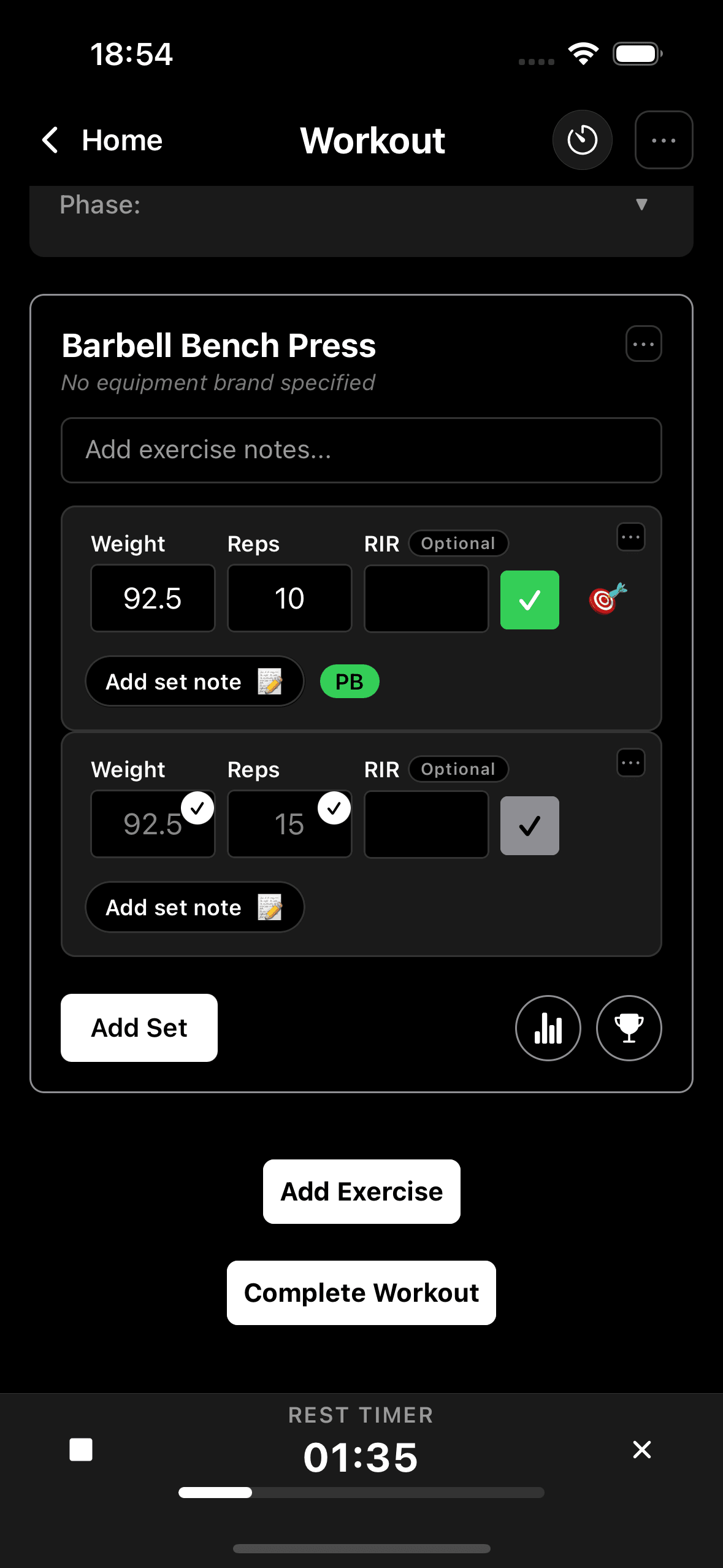
GainsLog, which I build, is a workout app for iPhone and iPad, and you can carry a workout on to your Apple Watch. It doesn't build a new workout each session. Its program builder, a Premium feature, asks for your equipment, experience, the muscles you want to prioritize, how many days you can train, how long a session can be and your split, and each workout repeats every week until the program ends or you change it. Weight and rep targets for exercises you've logged in the last 12 weeks are free, along with up to three saved workouts. On Fitbod, logging itself needs a subscription after the trial. The two apps side by side are in GainsLog vs Fitbod.
As of October 2026, GainsLog Premium costs $5.99 a week with a free trial or $39.99 a year, $40 to $56 less than Fitbod's yearly plans at $79.99 and $95.99 (Premium, App Store). The App Store also lists GainsLog Premium Lifetime at $79.99, paid once, which leaves out Gains Coach, GainsLog's AI coach.
Fitbod runs on Android, where GainsLog's app is in closed beta. It also keeps an equipment list for each gym with your own weight increments, while GainsLog's builder offers four setups: full gym, home gym, dumbbells only, and bodyweight or minimal equipment. GainsLog has no import or export. For more apps that plan for you, see Fitbod alternatives, Fitbod vs Hevy and the progressive overload app comparison.

If you'd rather follow a fixed program
If you want the same workouts each week, with weight and rep targets from what you logged at no cost, see how GainsLog works.
How this article was made
Researched and drafted with AI assistance from Fitbod's help center, website and App Store listings and from GainsLog's listings and code, checked against those pages on 29 October 2026. Prices change, so the pages used are listed below.
Sources
- Fitbod: how the trial works
- Fitbod: how to subscribe
- Fitbod: cancelling, refunds and pausing
- Fitbod: lifetime membership FAQ
- Fitbod: family plans and help article
- Fitbod: Family Sharing
- Fitbod: FSA and HSA funds
- Fitbod: how Fitbod creates your workout
- Fitbod: how it decides sets, reps and weight
- Fitbod: exercise variability
- Fitbod: weekly set targets
- Fitbod: My Plan
- Fitbod: system requirements
- Fitbod's website: prices
- Fitbod on the US App Store: prices
- Fitbod on the Swedish App Store: prices
- Garage Gym Reviews: Fitbod review: the earlier three-workout offer
- TechRadar: Fitbod app review
- Dr. Muscle: Fitbod review, written by a competing app
- GainsLog on the US App Store