 GainsLog
Is 3 Days a Week Enough to Build Muscle?
Most three-day plans fail the same way. The days get spent on a body part split, so every muscle is trained once a week. Spread the same weekly volume across three full body sessions and the problem goes away.
Table of Contents
Three days a week is enough. I have run full body three times a week for long stretches, and some of my best strength gains came out of exactly that setup.
If it did not work for you, the days are probably not the reason. The split is.
Frequency per muscle is the number that matters
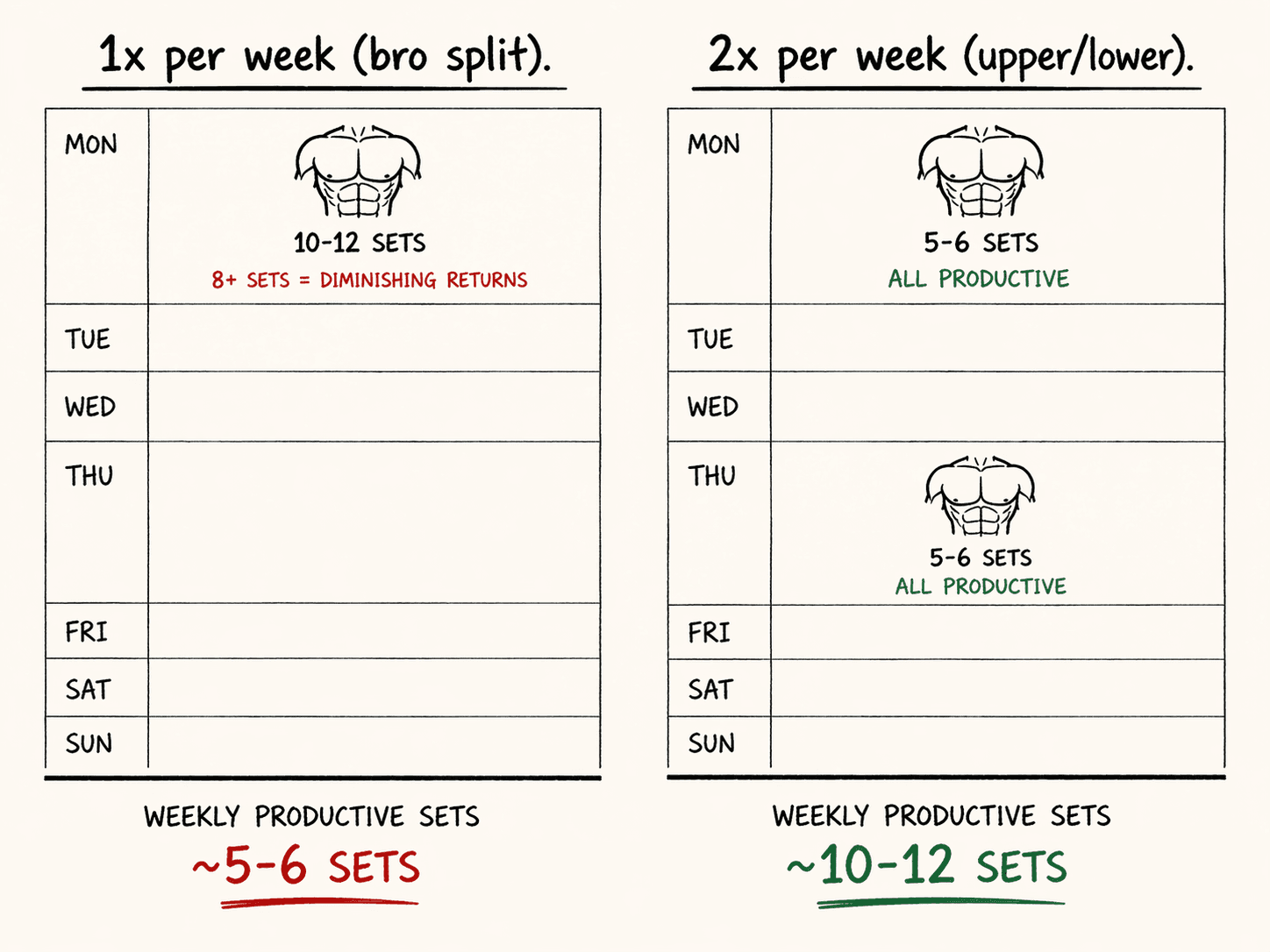
The research does not measure sessions per week. It measures how often each muscle is trained. A meta-analysis of training frequency found that two sessions per week per muscle group beat one, and there is little evidence that going above two adds much on its own.
So the question is not how many days you train. It is how many times each muscle gets trained, and whether the weekly volume is spread across those sessions or stacked into one.
The second half of that has a hard ceiling. Per-session volume for one muscle group tops out around 10 to 12 hard sets before the extra sets stop contributing. Two signals tell you that you crossed it: you start going through the motions, and you turn up to the next session for that muscle still under-recovered.
That ceiling sets your minimum frequency. If you want 16 hard sets for your back in a week, you cannot buy them in a single session. You need at least two.
How many sets a week is actually enough
The weekly target for most people sits between 8 and 15 hard sets per muscle. Below that you leave growth on the table. Above it, each extra set adds less than the one before.
That range is why frequency matters. A target you cannot fit into one session has to be split across several, and that split is what turns a weekly number into a weekly plan.
Beginners can start at the low end and still progress for months. If you are older or sleeping badly, stay closer to 8 than 15. Recovery decides where in the range you land.
A body part split wastes the days you have
The default advice for three days is push/pull/legs. Chest and triceps Monday, back and biceps Wednesday, legs Friday. It looks tidy on paper. Each muscle ends up trained once a week.
At that frequency you leave growth on the table, and the plan is brittle. Miss Wednesday and you do not train your back for two weeks. Not one. Two.
Full body fixes both. Three sessions, every muscle three times a week, and a missed session costs you almost nothing.
Three full body days train every muscle three times
The session is five or six exercises, repeated three times a week. Machines and cables rather than barbells, because the point is to load the muscle with as little technique risk as possible when you train close to failure alone.
The volume math is not close. Twelve to fifteen hard sets per muscle per week, spread over three sessions, is four to five sets per session. That sits well under the per-session ceiling, so every set is a set that counts.
The version I would run: leg press or hack squat, machine chest press, lat pulldown, seated cable row, machine lateral raise, and one triceps or biceps movement. Three sets of 8 to 10 on the compounds, two sets of 12 to 15 on the accessories.
Six exercises is enough. Four compounds cover most of the body. Two accessories round out side delts and arms, and the session stays under an hour.
Add a fourth day before you add more work
Three days is enough to make progress. It is not enough to do everything. If you want more isolation work, upper/lower on a fourth day is the honest answer.
Push/pull/legs only makes sense at five days a week or more. Below that, frequency per muscle drops too low to bother.
There is a trap in adding days, too. A plan you complete beats a plan you skip. If four sessions means you start missing them, three was the right number.
Hard sets are the ones that count
Three days is not a licence to train six exercises at half effort and call it hard. Proximity to failure is the prerequisite. Sets that stop well short of real effort do not count toward the weekly target no matter how many you log.
It is also not a reason to ignore progression. If your numbers are flat for a month, the program is not working, and adding days will not fix what a stalled progression is telling you.
Progression needs last session's numbers
None of this works if you cannot tell whether your numbers are moving. The system is the same exercises, the same order, and last session's weight in front of you.
GainsLog opens a workout with your last numbers already loaded, so the decision is always the same one: add a rep, add a small increment, or hold.