 GainsLog
The Best 3-Day Workout Split for Full Body Gains
The version most people land on for three days, push/pull/legs or an A/B rotation, trains each muscle too infrequently or scatters the comparison. The version that works is full body on stable machines, five or six exercises per session, repeated exactly the same way three times a week.
Table of Contents
- The Mistake: Splitting Your Workouts Too Much
- Frequency Matters More Than Most People Think
- The Second Mistake: A and B Sessions
- Why Machines Over Barbells
- A Note on Intensity
- The Program
- The Session
- Getting Stronger Over Time
- Common Mistakes When Training Three Days a Week
- When to Move On
- Frequently Asked Questions
- How GainsLog Fits In
Three days a week in the gym is enough to make real progress. I've run full body three times a week for long stretches over the years, and some of my best strength gains came out of exactly that setup. The trade-off is that you don't have room for a body part split, and full body done properly three times a week is genuinely hard. You're squatting, pressing, and pulling every session, and that adds up. If you want more room for accessories and body part focus, add a fourth day or more. If your priority is getting stronger and you only have three days, full body is the answer.
The version I'd run is not the version most people expect. No barbell lifts, no A and B sessions, no ten-exercise marathons. Machines and cable work, five or six exercises per session, and the same session every time you walk in.
The Mistake: Splitting Your Workouts Too Much
The default recommendation for three days is usually push/pull/legs. Chest and triceps Monday, back and biceps Wednesday, legs Friday. It looks clean on paper. It has a structural problem: each muscle only gets trained once a week. That's not enough frequency to get the most out of three sessions.
If you miss a session, it gets worse. Miss Wednesday and you don't train your back for two weeks. Not one. Two. By the time next Wednesday comes around, you've already slotted in your push day on Monday, and the whole rotation has shifted.
With full body, the frequency problem disappears and a missed session costs almost nothing. You trained everything two days ago, and you'll train everything again in two days. Nothing falls through the cracks.
Frequency Matters More Than Most People Think
On a push/pull/legs split with three training days, each muscle gets worked once a week. On full body, each muscle gets worked three times a week.
For most training loads, a muscle is ready to work again a couple of days later. On PPL, your chest sits fully recovered for four or five days before the next stimulus. On full body, you hit it again right when it's ready.
The total amount of work across the week can be identical either way. The difference is how it's distributed. For most people in their first few years of consistent training, three smaller doses spread across the week beat one large dose. This is even more true if you're a beginner. Squatting once a week isn't enough practice to learn the movement. Technique on compound lifts improves with repetition, and frequent repetition is how you get it.
The Second Mistake: A and B Sessions
The setup most people land on for full body is an A/B rotation. Squat, bench, and rows on A. Deadlift, overhead press, and pull-ups on B. Alternate across the week.
I'd drop that entirely. If you're training a muscle group three times a week, run the same exercises all three sessions. You get better at a movement by doing it repeatedly, and you compare like for like: the same exercise, same weight on the bar, last week's number sitting right there. A and B sessions force you to compare across different movements, and you lose the cleanest signal you have, which is the same lift from session to session.
This is also why stable exercises work so well here. When the movement is fixed and the machine does the stabilizing, the thing that changes over time is almost entirely strength. That makes the comparison honest.
Why Machines Over Barbells
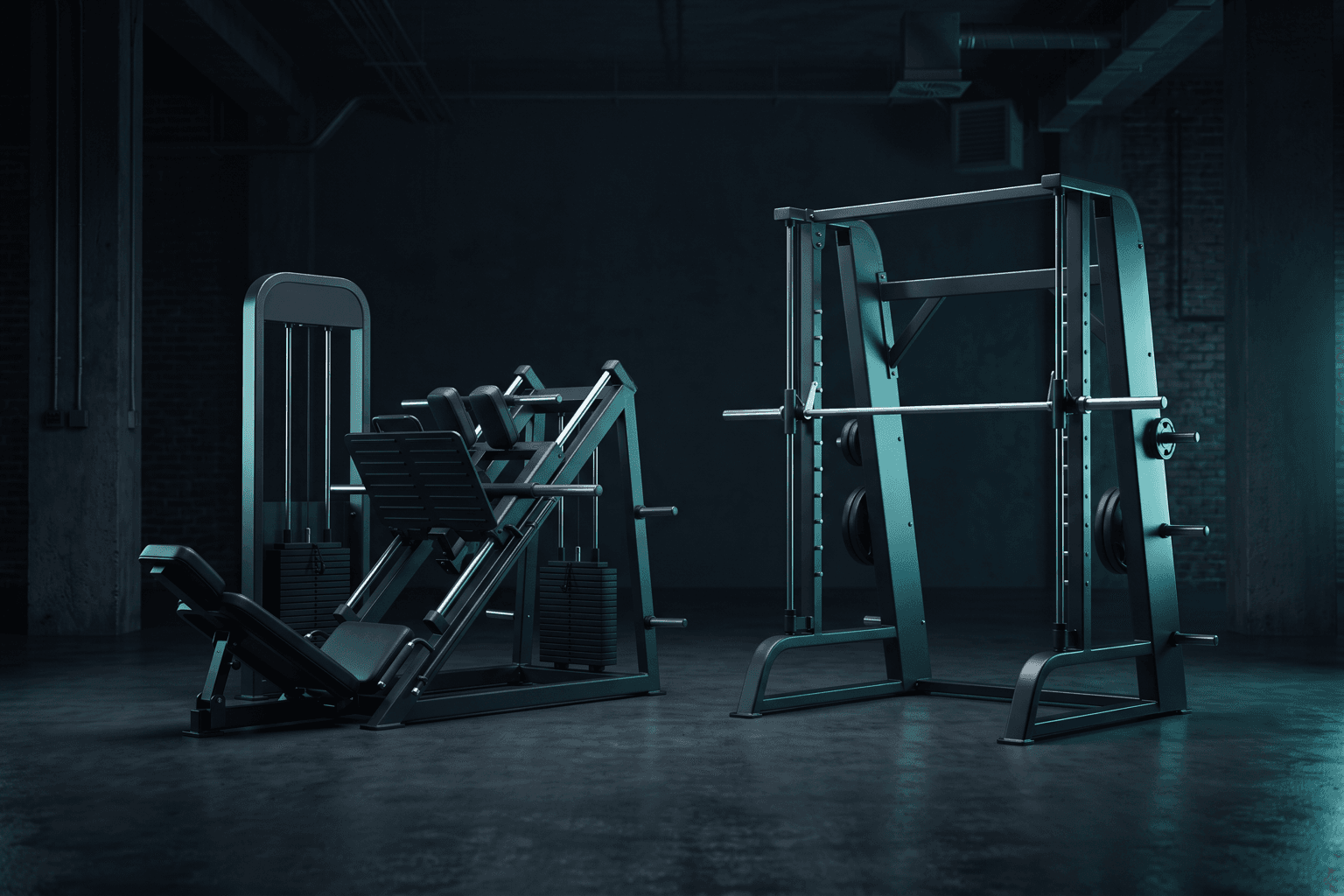
I program most lifts on machines, smith machines, and cables. Not because barbells are wrong. Because for a full body three-day split with limited exercises, stable movements are the better tool.
Machines hold you on the movement path, which means every set trains the target muscle instead of the stabilizers. Less technique to learn, less form to break down when the sets get hard. A smith machine squat or a hack squat loads the legs hard without the balance tax of a barbell on your back. A machine chest press keeps tension on the chest in a way a barbell bench loses at the bottom. A lat pulldown gives you the same lats as pull-ups without the grip or bodyweight ceiling.
There's a practical angle too. When you're taking sets close to failure, stable equipment is the safe way to do it. You can push a machine hard and fail safely, without a spotter, without bailing a barbell, and without the form collapsing at rep ten. That matters when you're training alone three times a week.
A Note on Intensity
If your sets aren't close to failure, the volume doesn't matter. Proximity to failure is the prerequisite, and 0-2 reps in reserve is the working range for almost everything on this list. The last few reps are the ones that build muscle. Everything before them is the price of admission.
Machines make this easier to hold. With a free weight, fatigue pushes you into ugly reps and you ease off to stay safe. With a machine, you can sit at the edge of failure without the risk, and the fixed path keeps the rep honest even when you're grinding.
The Program
One session, repeated three times a week. Same exercises, same order, same rep ranges. The A/B-free setup is the point.
The Session
- Leg press or hack squat: 3 x 8-10
- Machine chest press (or smith machine bench): 3 x 8-10
- Lat pulldown: 3 x 8-10
- Seated cable row: 3 x 8-10
- Machine lateral raise (or cable lateral raise): 2 x 12-15
- Tricep pushdown or machine curl: 2 x 12-15
Six exercises. Every muscle group gets trained three times a week, each session stays under an hour, and the whole thing fits on one screen.
The compound movements do most of the work, and the two accessories round out the side delts and arms. Keep the accessories light and don't overthink progression on them. The core of the program is the first four exercises.
This is a program for someone starting out or coming back to the gym. More advanced lifters can add a set here and there or swap in a slightly harder variation, but the structure holds. The exercise selection matters more than the split. Pick movements you can load progressively and stick with them.
Getting Stronger Over Time
The program is the easy part. What makes the difference is a system for progression.
When you can complete all your target reps across all sets, add a small amount of weight next session. For machines and smith machines, that's usually one increment on the stack or one small plate. If you added weight and the last set drops a rep or two, that's expected. Stay at that weight until you complete all the reps, then go up again.
This only works if you know what you lifted last time. It sounds obvious, but most people try to remember and get it wrong, or grab whatever weight feels about right. That's not progression. That's guessing. A notebook works. An app works. The key is having the data in front of you, not in your head.
Common Mistakes When Training Three Days a Week
- Splitting body parts too much. This is the big one. Three days and a body part split means everything gets trained once a week. Keep it full body.
- Too many exercises. Five or six per session is plenty. Every exercise you add takes away from your ability to push hard on the ones that matter. Compound movements cover a lot of ground.
- Running A and B sessions. Same exercises every session. The whole point of training three times a week is comparing the same lift against itself, and swapping movements kills that.
- Changing programs too often. Give it 8-12 weeks. If your numbers went up, it's working. Boredom is not a valid reason to switch.
- Adding weight when the form isn't there. Just because you hit 3 sets of 8 doesn't mean you should go heavier next time. If those sets were a grind, stay at that weight until it's solid before moving up.
When to Move On
If you've run a three-day full body program for a while and your progress has stalled despite good technique, adequate sleep, and honest effort, it might be time to add a fourth day. Upper/lower is the solid next step, and it really wants four days. Two upper days and two lower days gives you room for more volume and isolation work without sessions getting impossibly long.
I'd only recommend push/pull/legs at five days a week or more. Below that, frequency per muscle group drops too low. For most people, the practical choice is full body on three days or upper/lower on four.
Most people aren't at the point where they need to switch yet. Three days of consistent, focused training with progressive overload will get you further than you expect.
Frequently Asked Questions
Can I do cardio on off days? Yes. Walking, cycling, swimming. Just don't do anything intense the day before a heavy lower body session.
What if I can only go light on the machines? Higher reps. You'll need more reps to get the same training effect with lighter weight. Sets of 10-15 instead of 8. Not ideal for strength, but it works for muscle.
Should I change the rep ranges? The heavier sets build strength and muscle. The moderate sets build muscle. Both are useful. If you only care about size, you could shift everything to the 8-12 range, but I'd keep at least the leg press and chest press on the lower end.
How GainsLog Fits In
This program only works if you know what you did last session. Not what you think you did. What you actually did. That number is the whole progression system, and it's the one thing most lifters don't have in front of them.
GainsLog shows you exactly what you lifted last session when you open a workout, so the decision is always clear: add a rep, add a small increment, or hold. Same exercises, same order, three times a week, and the same comparison every single session. That's the setup this article is built on, and it's free on iOS (Android in beta).