

Hevy vs Jefit: Free Limits, Prices and Which to Pick
I build GainsLog, a third app, so read this page with that in mind. Pick Hevy if you want its watch apps on the free version, or the cheaper upgrade, at $23.99 a year as of November 2026. Pick Jefit if you want 1,400+ exercises with videos and 700+ ready-made plans to choose from for free, or a 12-week plan that Jefit rewrites each week, which needs Elite at $69.99 a year on its pricing page. Both apps charge for the suggested weight for your next session.
Which is better, Hevy or Jefit?
It depends on what you'll use for free and whether you'll pay. Hevy's free version saves 4 routines, shows workouts and stats from the last 3 months and includes its Apple Watch and Wear OS apps. Jefit's saves 2 plans, but each plan can hold up to 31 workouts, and it has 1,400+ exercises with videos; its watch app is free for 3 sessions. Both charge for next-weight suggestions. As of November 2026, Hevy Pro costs $23.99 a year and Jefit Elite $69.99 on its pricing page, in the US.
A third option, if you're on iPhone: GainsLog, the app I build, sets a weight and rep target for each set from what you logged, on its free version. Hevy and Jefit charge for their weight suggestions.
Every Hevy and Jefit fact below comes from their US and Swedish App Store listings, Hevy's help center and website, and Jefit's pricing page, feature pages and FAQ, read on 13 November 2026.
Hevy vs Jefit at a glance
| Hevy | Jefit | |
|---|---|---|
| Free saved workouts | 4 routines | 2 plans of up to 31 workouts each |
| Free custom exercises | 7 | 7 |
| Free history | Workouts and stats from the last 3 months | Every logged workout and exercise history; Progress-tab totals for the last 14 days |
| Exercises | 400+ with animations | 1,400+ with HD videos |
| Ready-made programs | 26 programs plus routines in 7 categories | 700+ Jefit plans and 20,000+ community plans; 400+ coach plans with Elite |
| Watch, free | Apple Watch and Wear OS apps included | 3 sessions, then Elite |
| Next-session weight | Pro; Hevy lists it under Trainer | Elite, on any plan |
| Apps | iPhone, iPad, Android, web, Apple Watch, Wear OS | iPhone, Android, web, Apple Watch, Wear OS |
| Paid plan, yearly | $23.99 | $69.99 on its pricing page |
What the free versions limit
Hevy's free version saves 4 routines, where a routine is one saved workout. It lets you create 7 custom exercises and shows workout and stats history for the last 3 months; Pro adds 1-year and all-time views (Hevy, Hevy). If you leave Pro, Hevy keeps the older history on its servers and shows it again when you resubscribe (Hevy). Its library has 400+ exercises, each with an animation (Hevy).
Jefit's free version keeps 2 plans, including plans saved from its library. A plan holds up to 31 training days, so one plan holds a whole split (Jefit FAQ). If each workout is its own routine, a five-day split needs five saved routines in Hevy, one more than the free version saves, though you can still log a workout without a routine (Hevy). Jefit's free version also allows 7 custom exercises and includes all 1,400+ exercises with HD demo videos (Jefit FAQ). Your logged workouts, each exercise's history and its 1RM chart are not capped, but the Progress tab's totals, such as volume and workout time, cover the last 14 days unless you pay for Elite (Jefit FAQ).
The watch apps differ most. Hevy's free version includes its Apple Watch and Wear OS apps (Hevy). Jefit's free version includes 3 watch sessions in total, and Elite makes them unlimited and adds heart rate and calories (Jefit). Jefit's watch app also needs your phone nearby (Jefit FAQ).
Hevy lists RPE tracking among its logging tools, not among its Pro features (Hevy); it's a setting you turn on to rate each set from 6 to 10 (Hevy). Jefit asks for one effort rating for the whole session when you finish (Jefit FAQ).
Hevy accounts are public by default, and its Discover feed stays on the home screen even with a private profile (Hevy). Jefit has a Discover tab where members share workouts, and says every social feature is optional (Jefit FAQ).
Who picks your next weight
In both free versions, you do. Hevy shows your last weight and reps for each exercise in a Previous column, from any workout or only the same routine, as you choose. A routine's weight and reps update when you save the workout, unless you turn that off or the exercise uses a rep range (Hevy, Hevy). Jefit pre-fills each set with what you did last time, estimates your one-rep max on every set and flags personal records (Jefit).
Both charge for the suggestions. Hevy lists its progressive overload recommendations under Hevy Trainer, which needs Pro and builds a program for you; Hevy's Trainer page describes the weight adjustments as part of each Trainer program (Hevy, Hevy). Jefit's Load Progression needs Elite. After each workout it suggests the weight, reps and target reps for each exercise in your next session, on any plan, including one you wrote yourself (Jefit, Jefit FAQ).
If you follow your own program and want the app to suggest the next weight, Jefit says Elite does that on your plan. Hevy's help center and Trainer page don't say whether its suggestions work outside a Trainer program. The progressive overload app comparison covers more apps that set your next weight.
Programs: Hevy Trainer or Jefit's Adaptive Plan
Hevy Trainer asks eleven questions, including your goal, experience, equipment, how often you want to train, workout length and a muscle group to focus on, and builds a program from the answers. Hevy says the programs come from an algorithm, not AI (Hevy). Trainer adjusts your working weights from your performance, and a variety setting can change some exercises every week (Hevy).
Jefit's Adaptive Plan, an Elite feature, asks for your goal, level, 1 to 7 workouts a week, session length, target muscles, equipment and injuries. It writes a 12-week plan in four-week blocks, with your split, exercises, sets, reps, weight and rest, and rewrites the coming week from the sets you logged (Jefit).
Both apps have ready-made programs. Hevy has 26 programs and routines in seven categories, which you can save and edit. Its free-versus-Pro table doesn't list the library as Pro, but saving a program adds each of its workouts as a routine, and the help center doesn't say whether those count toward the free 4 (Hevy, Hevy). Jefit lists 700+ plans built by Jefit and 20,000+ built by its users, which you can edit (Jefit); a free account keeps 2 of them at a time (Jefit FAQ).
What Hevy Pro and Jefit Elite cost
| Hevy Pro | Jefit Elite | |
|---|---|---|
| Monthly | US $2.99 or $3.99; Sweden 39 kr or 50 kr | $12.99 / 149 kr |
| Yearly | $23.99 / 295 kr | $69.99 on its pricing page; $34.99 and $35.99 also on the US listing; 499, 819 or 999 kr |
| Lifetime | $74.99 / 995 kr | None on its pricing page |
Jefit's pricing page says Elite is $69.99 a year in the US and shows it against a "regular price" of $155.88, twelve months at the monthly rate (Jefit). At the pricing page's $69.99, a year of Elite costs $46.00 more than a year of Hevy Pro and $5.00 less than Hevy's lifetime purchase (App Store).
Jefit's US listing also shows Elite Yearly products at $34.99 and $35.99, $11.00 and $12.00 more than Hevy Pro, and older "(Legacy Pricing)" products; its Swedish listing has the same kind of products (App Store, App Store). On both listings, one yearly product is labeled "(50% off)": $69.99 in the US and 999 kr in Sweden. Neither listing says who is offered which product. In Sweden, Jefit's yearly products cost 499, 819 or 999 kr, against 295 kr for Hevy Pro (App Store). Hevy's listings show two monthly prices without saying which you'll get. Jefit says the store shows the exact amount before you confirm, so check it in the app.
A few times a year, Hevy offers 50% off the first year of an annual plan to people who have never had Pro; it renews at the regular price, and lifetime is never discounted (Hevy). Jefit says its free trial is an offer it shows to some users, not to everyone (Jefit FAQ).
Moving your history between Hevy and Jefit
Both apps export your data. Hevy exports workouts and measurements as files you can open in a spreadsheet (Hevy), and every Jefit account can export its training data from jefit.com (Jefit FAQ).
Importing is harder. Hevy's import officially supports only CSV files exported from the Strong app. Its support team can send a sample file in Strong's format so you can try to match it, but converted files are not officially supported (Hevy). Jefit isn't a supported source, so don't count on a Jefit export importing into Hevy. Jefit's FAQ describes exporting but no import from another app. Expect to start a new log and keep the old app's export as your record.
Hevy or Jefit: which one to pick
- Pick Hevy if you'll stay free and log on an Apple Watch or Wear OS watch.
- Pick Hevy if you'll pay for the cheaper plan, at $23.99 or 295 kr a year, or want a lifetime purchase, at $74.99 or 995 kr.
- Pick Jefit if you'll stay free and want a large exercise library with videos and 700+ plans of its own to start from.
- Pick Jefit if your split has more than four workouts and you want each saved as its own routine or day, since one Jefit plan holds them all.
- If you'll pay so the app suggests your weights on a program you wrote, Jefit Elite does that. Hevy describes its suggestions as part of a Trainer program.
Where GainsLog fits
GainsLog is a workout app for iPhone and iPad, with an Apple Watch companion, for lifters who want to build muscle and be told what to lift each session. On the free version it logs unlimited workouts and sets a weight and rep target for each set from what you logged on that exercise in the last 12 weeks. Up to 3 saved workouts are free. Premium adds the program builder, five ready-made programs and custom exercises, at $5.99 a week with a free trial, or $39.99 a year on its Premium page, in the US (79 kr or 499 kr in Sweden). Its listing also shows other yearly products and a $79.99 lifetime purchase (App Store).
GainsLog lacks things Hevy and Jefit have. Its Android app is in closed beta, and it has no web app or social feed. Custom exercises need Premium, and it can't import or export your history. Its listing counts 100+ exercises, with machines first (App Store). Head-to-heads: GainsLog vs Hevy and Jefit vs GainsLog. For Hevy on its own, see the Hevy app review.
If you want the next weight set for you, free
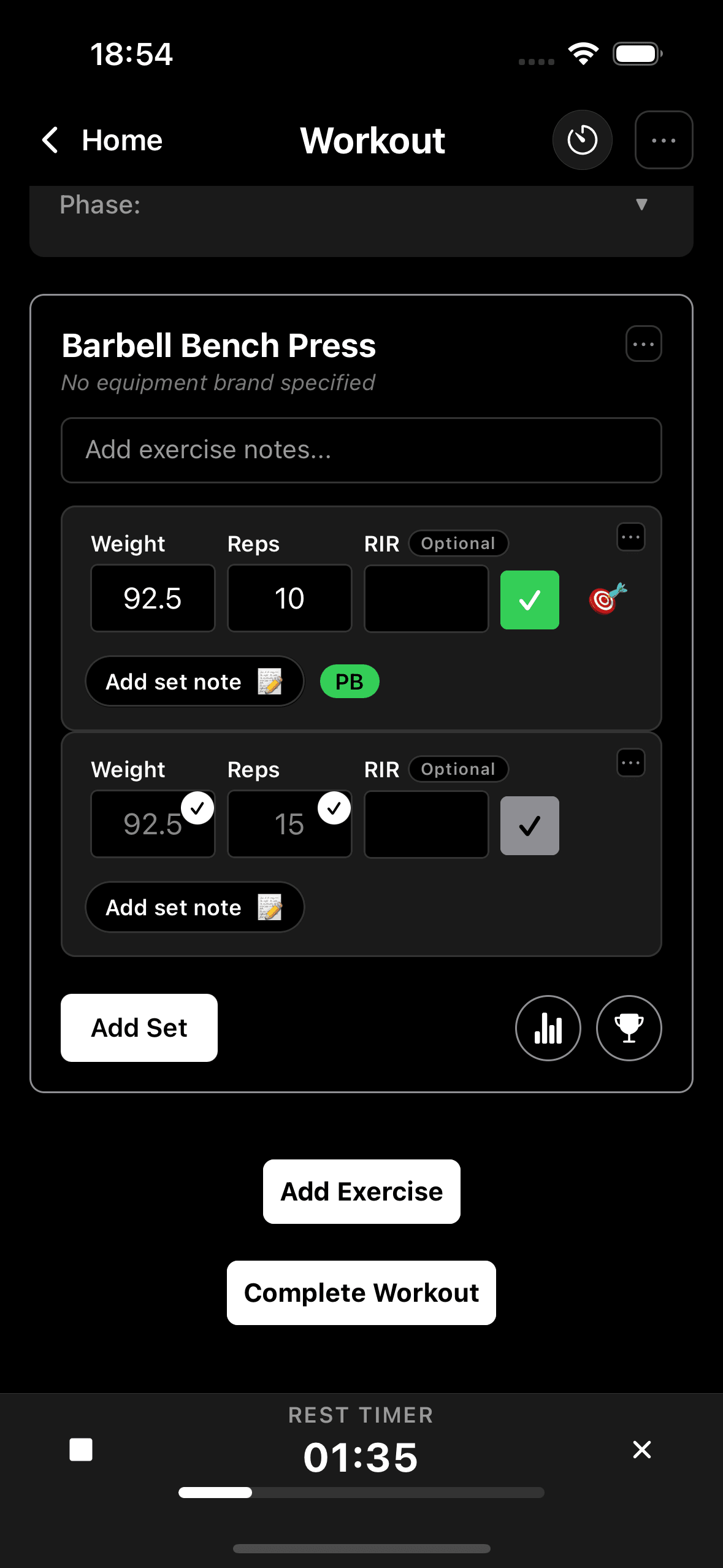
If you'd rather have each set's weight and reps set from what you logged without paying for it, see how GainsLog works.

How this article was made
Researched and drafted with AI assistance, then checked against the pages listed below and GainsLog's code on 13 November 2026. Prices change.
Sources
- Hevy on the US App Store: prices, platforms
- Hevy on the Swedish App Store: prices
- Hevy help: what Pro includes
- Hevy help: features guide: free vs Pro, platforms
- Hevy help: switching from Pro to free
- Hevy help: routine and program library
- Hevy help: exercise library
- Hevy help: previous workout values
- Hevy help: previous and routine values
- Hevy help: Hevy Trainer
- Hevy website: Hevy Trainer
- Hevy help: RPE vs RIR
- Hevy help: privacy settings
- Hevy help: exporting your data
- Hevy help: importing Strong data
- Hevy help: first-year sale
- Jefit on the US App Store: prices, platforms
- Jefit on the Swedish App Store: prices
- Jefit: Elite pricing and free vs Elite
- Jefit: FAQ: plans, exercises, watch, effort rating, export, trial
- Jefit: progressive overload and Load Progression
- Jefit: Adaptive Plan
- Jefit: workout plans
- GainsLog on the US App Store: prices, exercise library
- GainsLog Premium