

Gravl vs GainsLog: A Week at a Time or a Set Program?
I build GainsLog, so I have a stake in this comparison. The page has no affiliate links. Pick Gravl if you train on Android or a Garmin watch, or want the app to choose each workout's muscles from what has recovered, and you're ready to pay after 3 free workouts. Pick GainsLog if you're on iPhone and want the same workouts every week with a weight and rep target for each set. The targets are free; the program builder is Premium. As of November 2026, a year of Gravl costs $59.99 to $89.99 on its US listing and a year of GainsLog Premium $39.99.
Which is better, Gravl or GainsLog?
It depends on how fixed you want your training to be. Gravl plans your workouts a week at a time, and next week's workouts depend on what you log. Its recovery split picks each workout's muscles from what has recovered. GainsLog's program builder, a Premium feature, makes a program once that repeats the same workouts every week. Both suggest your next weights. Gravl lets you log 3 workouts before it asks you to subscribe; GainsLog's logging and per-set targets stay free. Gravl runs on iPhone, Android and Garmin watches; GainsLog on iPhone, iPad and Apple Watch.
Gravl's prices, features and rules below come from its US and Swedish App Store listings, its Google Play listing, its website and its help center, read on 23 November 2026. GainsLog's come from its listings, its Premium page and the app's code.
Gravl vs GainsLog at a glance
| Gravl | GainsLog | |
|---|---|---|
| AppsGainsLog's Android app is in closed beta. | iPhone, Android; Apple Watch, Wear OS and Garmin watches | iPhone, iPad, Apple Watch |
| How workouts are planned | Planned a week at a time; next week depends on what you log. A recovery split, a ready-made split or your own | A program built once (Premium); the same workouts every week |
| Next weight and reps | Suggested from your logged sets and how hard you rated them | Free: targets from your recent logs on that exercise |
| Without paying | 3 logged workouts (5 in South America), then a subscription | Logging, targets, 3 saved workouts, Apple Watch for a workout started on the iPhone |
| Yearly | $59.99, $79.99 or $89.99 | $39.99 |
| Lifetime | Sold on its website only | $79.99 in the App Store |
How Gravl and GainsLog plan your workouts
Gravl gives you three kinds of split. Its recovery split lets the app choose the muscles for each workout from your recovery and goals; the other two are Gravl's ready-made splits and splits you build yourself (Gravl help). Gravl's help page says the recovery split "keeps coming back to the muscles you have trained least recently and that are recovered enough to train" (Gravl help). Gravl generates next week's workouts when your week rolls over and shows one week at a time "because your next week's plan will partly depend on what you log this week" (Gravl help). Its homepage says Gravl recalculates the sets, reps and weights after every workout you log (Gravl). A Variety level setting decides how often the exercises change, and a Saved workout changes setting decides how much a saved workout's sets, reps and weights change when you repeat it (Gravl help).
GainsLog's program builder, a Premium feature, asks for your equipment, experience, the muscles you want to prioritize, how many days you can train, how long a session can be and, if you say you're experienced, your split. Before you start, it shows each muscle's weekly sets and checks them against ranges set for each muscle, such as 10 to 15 sets a week for a muscle you prioritize. Each workout then repeats every week with the same exercises and sets until the program ends or you change it. GainsLog also has five ready-made programs, also Premium.
With Gravl's recovery split, the muscles in each workout can change from week to week, and its Variety level decides how often the exercises change. In a GainsLog program, the exercises stay and the per-set targets change. To check a week of training against GainsLog's ranges, use the volume calculator, which has the same numbers as the app.
How each app picks your next weight
Gravl's App Store listing says it estimates your one-rep max from your logged history and prescribes the next session from it, with weights rounded to the plates or stack you have, and that rating a set Easy or Hard adjusts the next prescription (App Store). Gravl's help center describes an effort rating it asks for once you finish an exercise's sets, which you can switch off (Gravl help). Your first weights take into account your sex, bodyweight and experience level, and on machines Gravl keeps a separate estimate for each gym you train at (Gravl help).
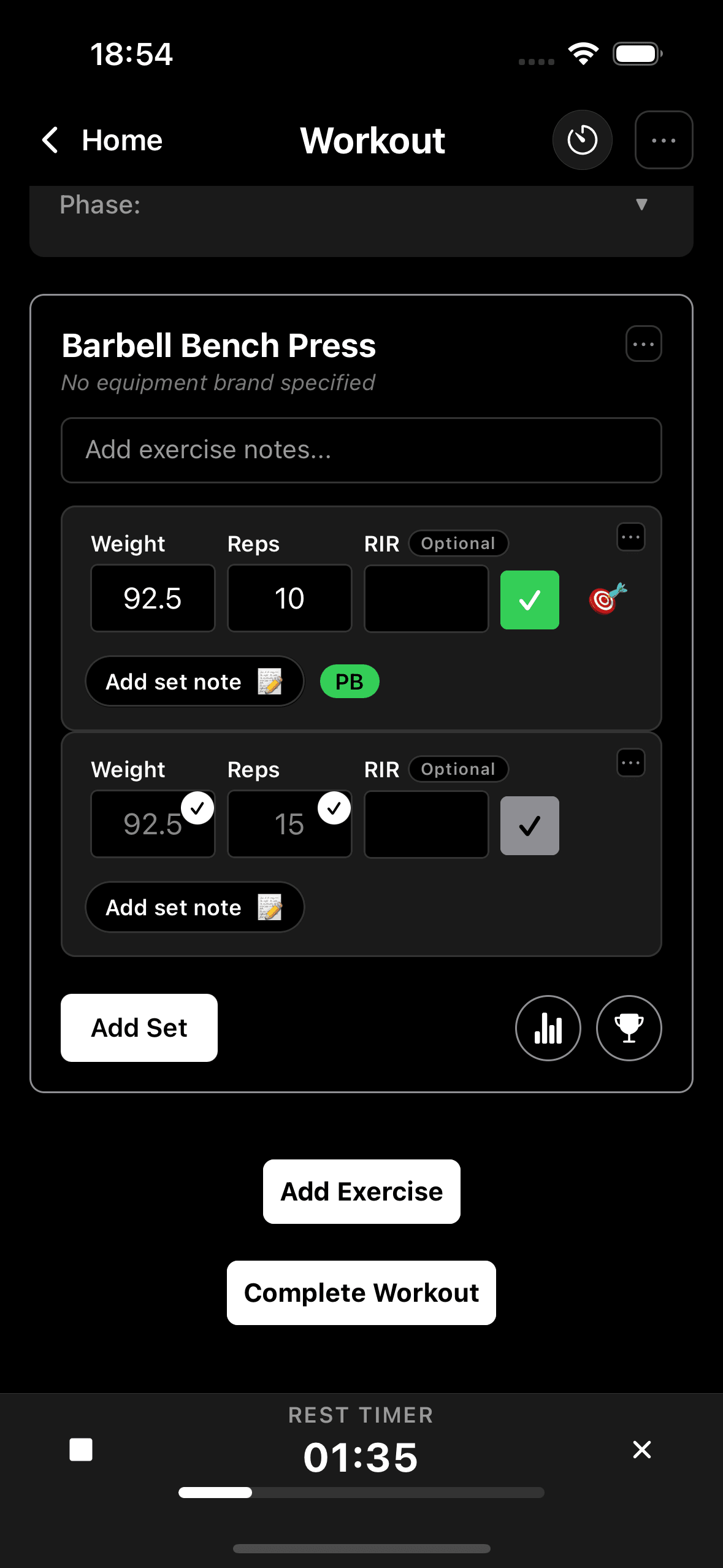
GainsLog sets a weight and rep target for each set from what you logged on that exercise recently. That is free. The weight-progression guide explains when a target goes up.
What Gravl and GainsLog cost
| Gravl | GainsLog Premium | |
|---|---|---|
| Weekly | None on its listing | $5.99 / 79 kr |
| Monthly | $14.99 / 199 kr | None on its Premium page |
| 3 months | $34.99 / 499 kr | None |
| Yearly | US $59.99, $79.99 or $89.99; Sweden 749, 799 or 999 kr | $39.99 / 499 kr; a $29.99 / 399 kr offer on its listing |
| Lifetime | On its website, price shown after you sign in | $79.99 / 999 kr |
Neither listing says who is offered which yearly price, so check it in the app before you pay. At Gravl's lowest yearly price, $59.99, it costs $20.00 more than GainsLog Premium's $39.99 (listed as GainsLog Pro Yearly Offer); at $89.99, $50.00 more. In Sweden the gap is 250 to 500 kr. Gravl's Swedish listing also shows packs of 10, 35 and 100 credits (129, 249 and 399 kr) that its description doesn't explain (App Store). GainsLog's listing shows two products named Gains Premium, at $14.99 and $49.99, that its Premium page doesn't list (App Store).
Gravl sells its lifetime plan only on its website, not in the App Store or Google Play, and shows the price after you sign in (Gravl help). GainsLog's lifetime purchase is in the App Store and includes everything in Premium except Gains Coach, its AI coach.
Where Gravl is better
- Android and more watches. Gravl is on Google Play with a Wear OS app (Google Play), and also runs on Garmin watches (Gravl help). GainsLog's Android app is in closed beta and its watch app is for Apple Watch only.
- Training days that change. Gravl's help page says its recovery split suits people who train on different days and times each week, and that if you skip a muscle in a session, later workouts compensate (Gravl help).
- Bringing in a plan from elsewhere. Gravl's site says it turns a routine from Instagram or TikTok, a photo or a PDF into a workout you can log (Gravl).
- Exercise videos. Gravl's listing advertises 300+ trainer-led exercise videos you can download for offline use (App Store).
Gravl or GainsLog: which one to pick
- Pick Gravl if you're on Android, train with a Garmin or Wear OS watch, or want the app to decide each workout's muscles, and you're ready to pay after 3 workouts.
- Pick GainsLog if you're on iPhone and want the same exercises each week. The weight and rep targets are free; pay for Premium if you want the program built around your schedule and the muscles you want to prioritize, at $39.99 a year.
- GainsLog can't import Gravl's history, so switching means starting a new log.
- If you're also weighing Fitbod, see the Fitbod alternatives and GainsLog vs Fitbod. For more apps that set your next weight, see the progressive overload app comparison.
Try GainsLog
The free weight and rep targets are in the app: see how GainsLog works.

How this article was made
Researched and drafted with AI assistance from Gravl's App Store and Google Play listings, website and help center, and from GainsLog's listings and code, checked against those pages on 23 November 2026.
Sources
- Gravl on the US App Store: prices, weights, platforms, videos
- Gravl on the Swedish App Store: prices
- Gravl on Google Play: Android, Wear OS
- Gravl: workout import
- Gravl help: managing your subscription: free workouts
- Gravl help: set up your fitness plan: splits, variety, saved workouts
- Gravl help: the recovery split
- Gravl help: upcoming workouts: one week at a time
- Gravl help: recommended weights
- Gravl help: lifetime plan
- Gravl help: watch apps
- GainsLog on the US App Store: prices, platforms
- GainsLog on the Swedish App Store: prices
- GainsLog Premium: plans, Gains Coach
- GainsLog app: Lifetime excludes Gains Coach