

Why am I not seeing results at the gym?
Check whether your lifts are going up. If they are, your training is probably working, and the next things to look at are time and how you measure. If they've stalled, rule out sleep, stress and dieting first, then look at the training itself.
Table of Contents
- Start with your log
- If your lifts are going up, has it been long enough to see?
- Is something besides training holding you back?
- What if one muscle lags behind?
- If your lifts have stalled, rule out the things outside the gym first
- Are your sets hard enough?
- Does your program add weight over time?
- Are you changing exercises or programs too often?
- Are you doing more than you recover from?
- What to do at your next session
"Not seeing results" covers two different problems, and the fix for one does nothing for the other. Changing your program won't help if it was working and you just haven't waited long enough. Waiting won't help if your sets stop well short of failure.
Start with your log
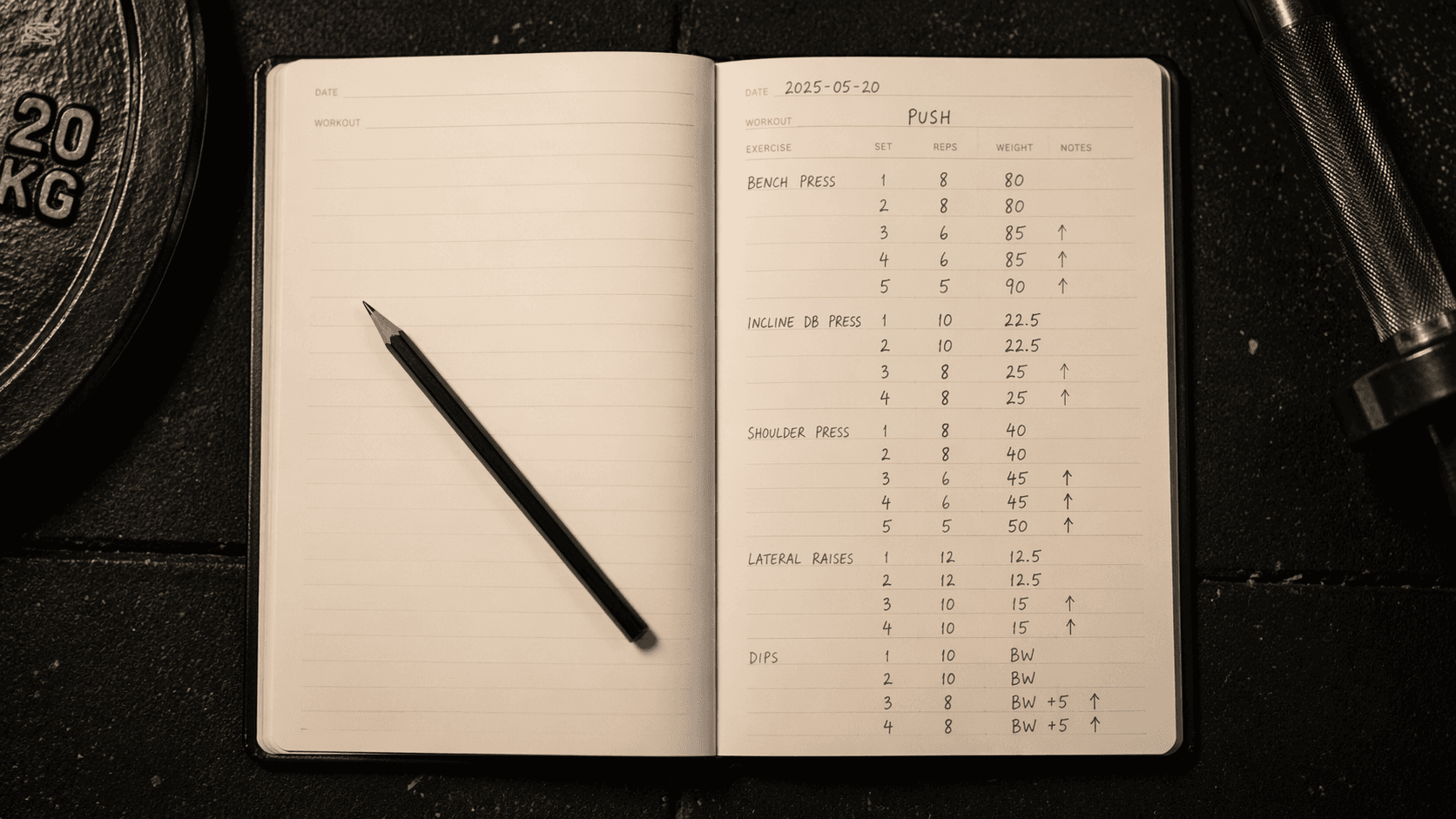
Pick three or four exercises you do every week. Compare your weight and reps from the last session with the same exercise four to six weeks ago.
If you don't keep a log, you can't make that comparison yet, but you don't have to wait to change anything. Start one today. For every working set, write down the exercise, the weight, the reps, and how many more reps you think you could have done. That last number is called reps in reserve, or RIR. Then use the effort and progression rules further down at your next session. They apply whatever your log would have shown. Our article on why tracking matters goes into more detail.
Keep the comparison fair. Same exercise, same machine or setup, similar rest between sets. Six weeks of numbers is enough to see a trend on most exercises.
GainsLog's training principles use strength as the main sign of muscle growth. That means adding weight or reps in sets of roughly 4 to 10 reps, on exercises chosen for muscle growth, done the same way each time. In your first months, part of the gain is skill, so strength can rise faster than muscle. Numbers that haven't moved in six weeks tell you something has to change. Our guide to progressive overload explains why GainsLog uses strength this way. That's why the log comes first. It tells you which half of this article to read.
If your lifts are going up, has it been long enough to see?
Muscle grows slowly. In one study, ten untrained young men increased the cross-sectional area of a thigh muscle, the size of its cross-section on an ultrasound scan, by about 10% over ten weeks. Part of the increase measured at three weeks was swelling from muscle damage, not new muscle. Damas et al., 2016
Take photos in the same light and pose once a month. Measure your upper arms, chest and waist on the same day. Compare month to month.
Is something besides training holding you back?
If your waist measurement has been rising about as fast as your arms, you may be building muscle under fat that makes it harder to see. If your bodyweight hasn't changed in months and you want to get bigger, food may be what's missing. Both are nutrition questions, and this article stays with the training. Our guides on getting out of skinny fat and choosing between a bulk and a cut cover them.
What if one muscle lags behind?
A big lift like the bench press can keep rising while one of the muscles it trains lags, since it also depends on your shoulders, triceps and technique. Judge each muscle by an exercise that targets it, like a machine chest press or a fly for the chest. If that exercise stops rising, or the muscle hasn't changed in your photos or measurements over a couple of months, add one or two weekly sets for it. A meta-analysis of 67 studies with 2,058 participants found that more weekly sets produced more muscle growth, with smaller additional gains for each set added. Pelland et al., 2026
If your lifts have stalled, rule out the things outside the gym first
Lifts stall for reasons that have nothing to do with your program. If you're dieting to lose fat, holding your strength can be a good result. Short sleep and stressful weeks can also hold back a session. If one of these explains the stall, fix it or wait it out before you change the program.
If none of them applies, work through the questions below in order.
Are your sets hard enough?
An analysis of 55 hypertrophy studies found that muscle growth tended to increase as sets ended closer to failure. Robinson et al., 2024
Failure here means the rep you can't complete with good technique. You don't need to reach it on every set. Another meta-analysis found only a trivial advantage for training to failure over stopping short of it. Refalo et al., 2023
You're probably stopping further from failure than you think. When people predict how many reps they have left, they underestimate by about one rep on average, with wide variation between people. Predictions were more accurate close to failure and in sets of 12 reps or fewer. Halperin et al., 2022 A set you rate as two reps from failure may be three. Our guide to reps in reserve explains how to use that number.
You can check your own estimates. On a machine where you can stop safely at any point, like a seated chest press or a leg extension, predict your reps left on the last set, then keep going until a rep fails. Don't test this on barbell squats, the bench press without a spotter, or the leg press. The result calibrates that exercise, not every exercise, so repeat it now and then on others.
Does your program add weight over time?
Some programs say "3 × 10 at 50 kg" and stay that way for months. Once you can do 10 reps at 50 kg on every set, the next session should be heavier, and a fixed weight never is.
GainsLog's training principles use a rep range instead, such as 8 to 12. When you reach the top of the range on every set, add the smallest weight increment the machine or bar allows. Your reps will drop, and you build them back up to 12.
For three sets of a chest press at 8 to 12 reps, hitting 12, 12 and 12 with one or two reps left means it's time for a little more weight. That's progressive overload in practice.
Are you changing exercises or programs too often?
In one eight-week study, trained men who had their exercises randomized every session grew about as much as those who kept the same exercises, and they enjoyed training more. Baz-Valle et al., 2019
Variety didn't cost those men muscle, but it does take away the comparison. If this week's incline press replaces last week's flat press, you can't tell whether you're progressing. Keep your main exercises until you have several weeks of numbers to compare. Swap one when it causes pain, the equipment isn't available, or it has stopped progressing with everything else in place.
Are you doing more than you recover from?
Effort can go wrong in the other direction too. If you take every set to failure and do a lot of sets, you may stop recovering between sessions. Reps that drop across the week, aching joints and sessions you dread are common signs.
Coaches often handle this with a reset, though none of the studies cited here tested it. For three to four weeks, leave one or two reps in reserve on most sets, and cut your sets back to what you did when you were last progressing. If you don't know that number, drop one or two sets from each exercise. Add sets back one at a time when your numbers move again. If you want a low-volume program to reset with, our two-day full-body program starts at one or two hard sets per exercise.
The log tells you which of the two you have. Flat numbers and easy sessions point to effort. Flat or falling numbers and exhausting sessions point to recovery.
What to do at your next session
- Log every working set: exercise, weight, reps, and reps in reserve.
- Choose your main exercises and keep them while you collect numbers to compare.
- Give each exercise a rep range, and add weight when you reach the top of it on every set.
- On one safe machine exercise, check your reps-in-reserve estimate against a set taken to failure.
Then take photos and measurements once a month. After four to six weeks, compare your log and go back to the section that matches it.
GainsLog for iPhone puts last session's weight and reps on screen before each set, so the comparison is there while you train.